- January 27, 2026
- Posted by: admin
- Category: BitCoin, Blockchain, Cryptocurrency, Investments
The XRP Ledger, a decentralized public blockchain developed by Ripple, has surpassed $1 billion in total on-chain assets, according to recent reports. This growth is apparently being fueled by Ripple’s stablecoin RLUSD, and other asset classes which continue to attract significant interest on the blockchain network.
XRP Ledger Achieves Monumental Milestone
The XRP Ledger crossed a significant financial milestone this week, with reports confirming that more than $1 billion in tokenized assets are now held directly on its blockchain. This surge highlights the growing confidence in Ripple’s infrastructure as a platform for tokenized finance and Real-World Asset (RWA) integration. It also cements XRPL’s role as a core bridge between traditional finance and blockchain technology.
Data from analytics firm RWA.xyz shows that stablecoins and tokenized instruments are driving much of this ledger growth. In particular, the RLUSD stablecoin has emerged as the most active asset on the blockchain, attracting increasing investment flows and a growing base of holders.
At the time of writing, the XRP Ledger hosts approximately $338,005,246 in RLUSD, held across 33,105 addresses. Notably, both investment volume and holder count are at their highest levels ever recorded among other tokenized assets on the network. Beyond RLUSD, other stablecoins, including Circle’s USDC, Braza USDB, BBRL, and EURØP, have also contributed significantly to the overall rise in the value of tokenized assets on the ledger.
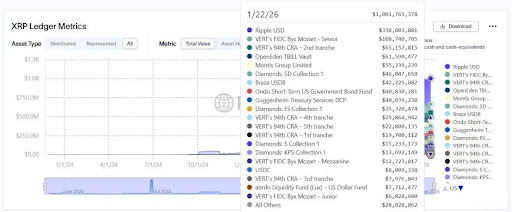
Institutional participation is further accelerating this growth as banks and financial firms explore tokenizing funds, treasury products, and credit instruments on the XRP Ledger. On-chain data shows that the second-largest contributor the $1 billion tokenized asset milestone came from the private credit sector.
The largest single private credit allocation on the network totaled approximately $108,740,785, issued through the Vert Capital platform and held by a single address. After private credit, other asset classes that have also fueled XRPL’s growth include US treasury debt, commodities, private equity, real estate, etc.
Reasons Why Ripple’s Ledger Is Standing Out
Behind the scenes, several factors are driving the XRP Ledger’s growth and helping it stand out among the competing blockchain networks. Paul Barron, the founder of the Paul Barron Network, has suggested that XRPL’s fast settlement times, high scalability, and low transaction costs make it an incredibly attractive option for institutional users.
The ledger’s compliance-focused architecture is another major catalyst for adoption. This design enables financial firms to tokenize funds, treasuries, and stablecoins while remaining aligned with regulatory standards. In addition, security enhancements on the blockchain network, including the integration of quantum-resistant Dilithium cryptography, are strengthening institutional trust and reinforcing XRPL’s long-term resilience.
Barron has described the Ledger as “the world’s financial infrastructure,” suggesting that its evolving role in tokenized assets and institutional finance positions the network as a foundational layer for the future of global payments.