- February 4, 2026
- Posted by: admin
- Category: BitCoin, Blockchain, Cryptocurrency, Investments
The key to understanding Bitcoin’s current market phase is not forecasting short-term price direction, but analyzing structure—where capital is concentrated, how that capital is financed, and whether fresh demand is entering the system. A recent CryptoQuant report shifts the focus away from narratives and toward these underlying mechanics, highlighting Strategy as a central structural reference point.
According to CryptoQuant analyst Maartunn, Strategy’s average Bitcoin acquisition price around $76,000 has emerged as a critical level for the broader market. This price was not intentionally targeted as support, but the sheer volume of Bitcoin accumulated at this level makes it impossible to ignore. As market price gravitates toward this zone, the question is no longer whether Bitcoin is bullish or bearish, but whether the market can absorb supply and hold without exposing deeper stress.
This level also carries significance beyond spot price action. Strategy’s accumulation has been financed through capital markets, including equity issuance and convertible debt, linking Bitcoin’s market structure to broader liquidity conditions. If price weakens toward this area while funding conditions tighten, the sustainability of structural demand comes into focus.
Structural Leverage And Strategy’s Test Zone
A CryptoQuant analyst notes that leverage in this cycle extends beyond derivatives and into capital markets. Although Strategy is not employing short-term trading leverage, its Bitcoin accumulation has been financed through equity issuance and convertible bonds. This places growing importance on the capital-market window remaining open. If Bitcoin prices and Strategy’s equity weaken simultaneously while funding conditions tighten, the firm’s ability to sustain accumulation diminishes, reducing a key source of structural demand.
On-chain data reinforces this cautious framework. Bitcoin’s Realized Cap has struggled to expand despite large price swings, suggesting rotation among existing holders rather than meaningful new inflows. In this environment, upside moves are more likely to be driven by short covering or temporary liquidity effects than by durable spot demand.

SOPR further supports this view. With SOPR frequently below 1, short-term holders continue to realize losses and exit positions. While this dynamic can fuel relief rallies, historical trend reversals usually require SOPR to reclaim and hold above the 1.0 threshold.
Despite these constraints, accumulation has not stopped entirely. On Monday, Michael Saylor announced that Strategy acquired 855 BTC for approximately $75.3 million at an average price of $87,974. As of February 1, 2026, Strategy holds 713,502 BTC, acquired for roughly $54.26 billion at an average cost of $76,052.
Until spot volume, ETF inflows, and Realized Cap reaccelerate together, the base case remains broad consolidation. The $76,000 level is not a guaranteed floor, but a structural test—this remains a market defined by structure, not price.
Bitcoin Breaks Key Support
Bitcoin’s price action on this daily chart confirms a decisive shift in market structure toward a bearish regime. After failing multiple times to reclaim the declining short-term and medium-term moving averages, BTC has accelerated to the downside, breaking below the $80,000 psychological level and tagging the $78,000–$77,000 zone.
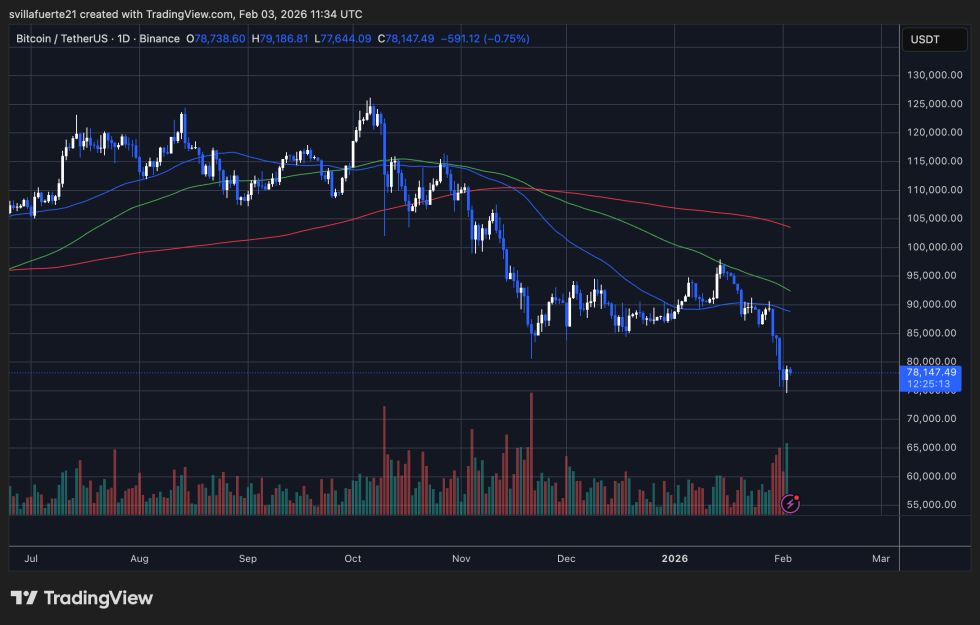
This area now represents the first meaningful demand region, but the manner in which price arrived there is important: the move was impulsive, with expanding red volume bars, signaling active distribution rather than passive consolidation.
Structurally, Bitcoin remains below its 50-day and 100-day moving averages, both of which are sloping downward, reinforcing bearish momentum. The 200-day moving average, still trending higher near the low-$100,000s, is now far above price, highlighting how extended the correction has become relative to the prior uptrend. Rallies over the past several weeks have consistently stalled beneath falling resistance, forming a series of lower highs that define a clear downtrend.
As long as BTC holds below former support turned resistance near $85,000–$88,000, the risk of further downside or prolonged consolidation remains elevated. The market appears focused on finding acceptance at lower levels rather than initiating a sustained recovery.
Featured image from ChatGPT, chart from TradingView.com