- August 12, 2026
- Posted by: admin
- Category: BitCoin, Blockchain, Cryptocurrency, Investments
Bitcoin financial services firm Fold could address its Nasdaq share-price problem through a potential reverse split, but the company’s shrinking Bitcoin reserve raises a separate question about how it will fund operations.
The company’s Aug. 11 quarterly filing reported that, as of June 30, Fold held 194 BTC worth $11.4 million in its investment treasury after selling 832 BTC during the six months ended June 30.
On that same date, it held another 77 BTC worth $4.5 million in a rewards treasury, but that balance was matched to a Bitcoin-denominated customer rewards liability. The combined total was 271 BTC, though the two buckets were not economically interchangeable.
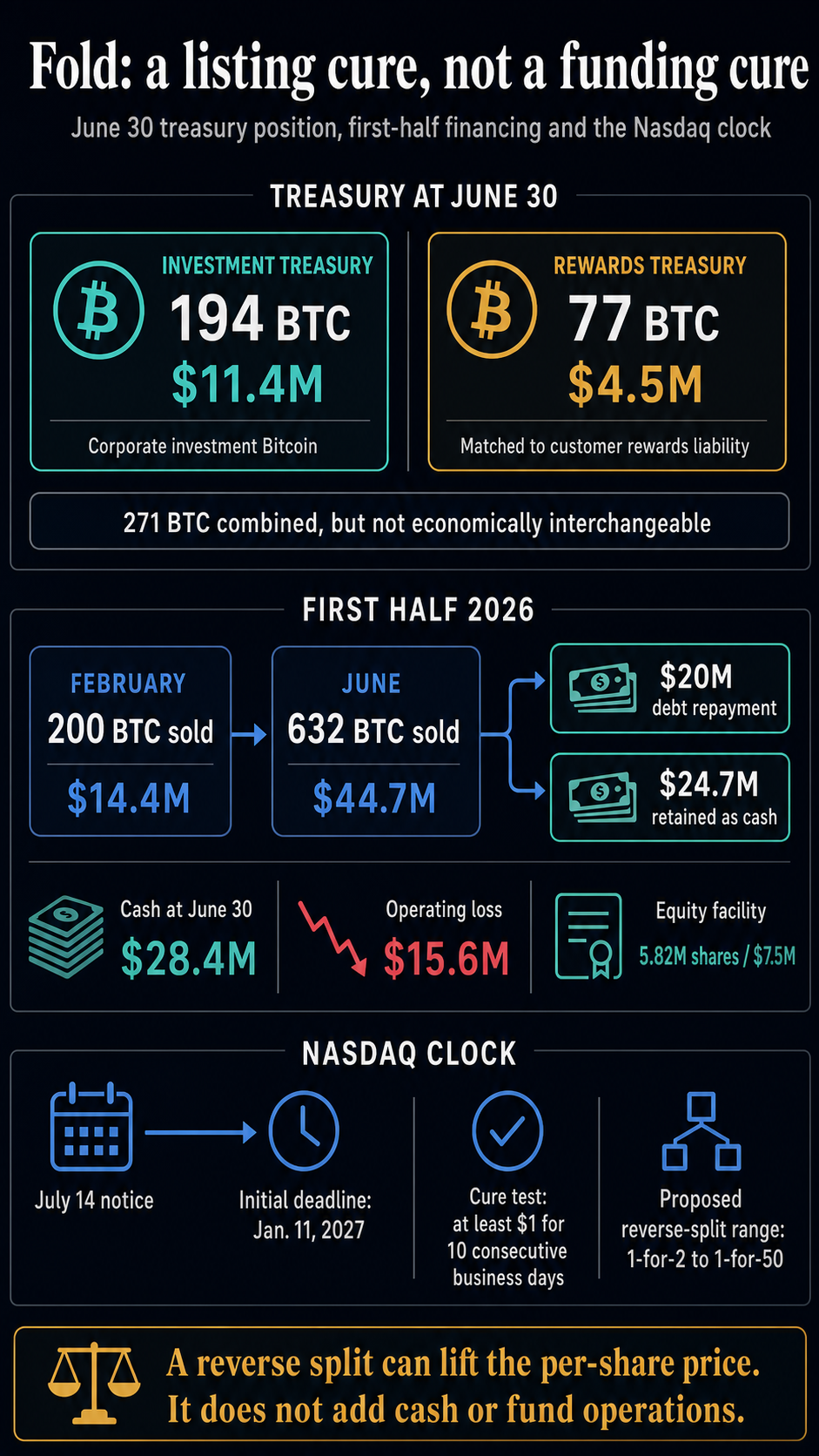
A reverse stock split could lift Fold’s nominal share price without raising cash, issuing new shares, or consuming Bitcoin. That could help the company regain Nasdaq compliance, but it would not pay operating expenses. Fold reported a $15.6 million operating loss for the first six months of 2026, making dilution and further use of the investment treasury possible financing risks, not necessary outcomes.

Debt cleanup left a smaller treasury
Fold sold 200 BTC for $14.4 million in February and 632 BTC for $44.7 million in June. It used $20 million of the June proceeds to repay its Bitcoin-backed credit facility and retained the remaining $24.7 million as cash.

Those sales were separate from the return of 500 BTC to an investor when an earlier note was extinguished. That transfer did not generate sale proceeds and is not part of the 832 BTC sold during the half.
Fold reported $28.4 million in cash and cash equivalents at June 30. The company also raised additional liquidity by selling about 5.82 million shares for $7.5 million under its equity facility during the first half. Fold has not said how it would cover future cash needs without returning to stock sales or using more of the investment treasury.

Nasdaq notified Fold on July 14 that its shares had closed below the exchange’s $1 minimum for 30 consecutive business days. The notice had no immediate effect on the listing and gave Fold an initial cure period through Jan. 11, 2027.
To regain compliance, Fold’s shares must close at or above $1 for at least 10 consecutive business days, or longer if Nasdaq requires. The company may qualify for another 180-day period if it meets the exchange’s other conditions.
Fold is seeking shareholder authority for a reverse split ranging from 1-for-2 to 1-for-50. Its filing does not say that a ratio has been selected or that a split has been implemented. If Fold uses that authority, the maneuver could address the bid-price requirement without changing the company’s underlying cash position.
The downside risk remains conditional. Under Fold’s February investor-note terms, an actual failure to maintain its Nasdaq listing would constitute an event of default on the $13 million note. The current deficiency notice is not a delisting and did not itself trigger that provision.
Fold could therefore restore compliance without selling Bitcoin or raising equity if its stock recovers or a reverse split takes effect. What remains unanswered is how the company will fund continuing operations while protecting the 194 BTC it reported in its investment treasury as of June 30.
The post After selling 832 BTC to clear debt, this Nasdaq-listed crypto firm is using a 1-for-50 reverse split to mask its shrinking treasury appeared first on CryptoSlate.